
In questa pagina
Ne abbiamo parlato sui social
Beden önermek için müşterinin fotoğrafı şart mı? 3DLOOK gibi araçlar ölçüyü önden ve yandan çekilen iki telefon fotoğrafından çıkarıyor. Bu da bir yol. Ama müşteri kamerayı açmalı, poz vermeli, fotoğrafını paylaşmalı. YourSizer'da müşteri yalnızca boyunu ve kilosunu yazıyor. Ürüne göre bedenini görü
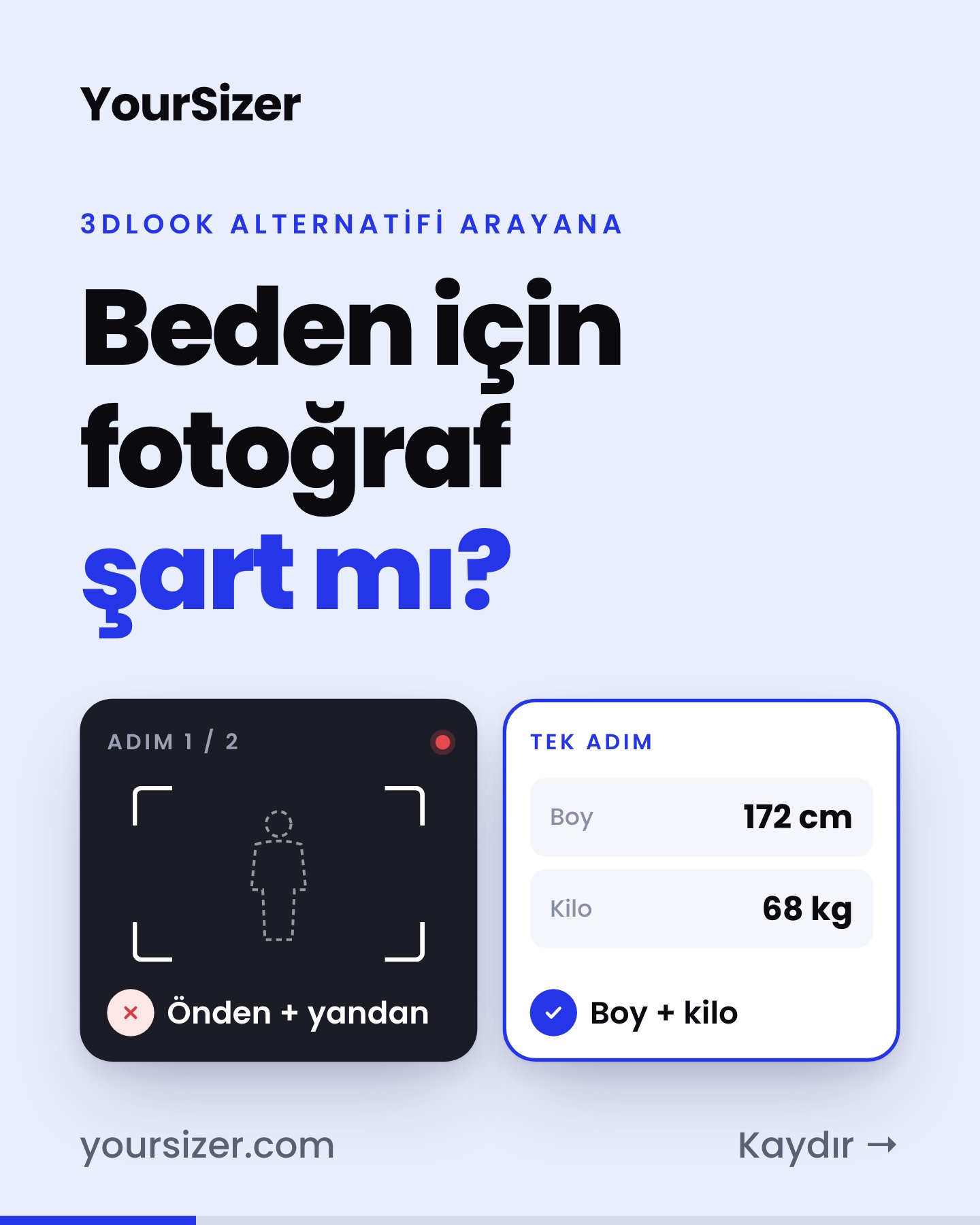
If you searched for "3DLOOK alternatives", you are probably in one of two situations. Either you run a fashion store and want shoppers to pick the right size without a body scan, or you looked at 3DLOOK and found that it no longer fits what you need. This guide covers both. It explains what 3DLOOK does today, which kinds of tools can replace it, and how to pick one for your store.
What 3DLOOK does today
3DLOOK is best known for measuring bodies from phone photos. Its Mobile Tailor page says the shopper takes two photos, one from the front and one from the side, and the system returns 80+ body measurements. The same page lists who it is built for: made-to-measure brands, on-demand manufacturing, bridal and tuxedo businesses, custom apparel and uniform makers.
The company's focus has also moved. The old YourFit address, which used to cover its fashion fitting product, now opens a page for FitXpress, a body-data product for health and fitness, with BMI checks and telehealth use cases. The 3DLOOK homepage leads with the same health and fitness offer, while fashion sits under a "Made-to-Measure" menu.
That explains a lot of the searches. A ready-to-wear fashion store that wants size advice on its product pages may now look elsewhere, simply because the product it remembers is no longer the vendor's main focus.
Why stores look for a 3DLOOK alternative
The reasons usually fall into four groups:
- Scan friction. Asking a shopper to stand in fitted clothes and take front and side photos is a big ask on a product page. It works well for a tailor or a uniform fitting, where the customer expects to be measured. It is harder for someone browsing a t-shirt on their phone.
- Privacy worries. Body photos are sensitive. Some shoppers will not share them with a store they have never bought from. We cover this in more detail in what shoppers expect from body-data privacy.
- Wrong use case. Made-to-measure needs exact body numbers. Ready-to-wear needs a size label: S, M or L, 38 or 40. Those are different problems, and a tool built for one is not always best for the other.
- Platform fit. A store on Shopify or a Turkish platform such as ikas or Ticimax wants an app or module it can switch on, not an SDK its developers must wire up.
The main types of 3DLOOK alternatives
Not every alternative works the same way. Before comparing brand names, decide which approach suits your shoppers.
| Approach | What the shopper does | Best for | Trade-off |
|---|---|---|---|
| Photo-based body measuring (3DLOOK style) | Takes front and side photos | Made-to-measure, uniforms, bridal | High effort, privacy concerns |
| Questionnaire size recommender | Answers a few questions (height, weight, fit preference) | Ready-to-wear stores of any size | Depends on good size charts |
| Purchase-history matching | Picks a garment they own from another brand | Large retailers with big catalogs | Needs past orders and brand data |
| Photo virtual try-on | Uploads a photo to see the garment on themselves | Showing style and look before buying | Shows look, not exact size on its own |
| Size recommender plus try-on | Answers questions, then optionally tries on | Stores that want both size and look | More features to set up |
Well-known 3DLOOK alternatives compared
Below are tools that often come up when stores compare options. Each description is based on what the vendor says on its own site; check details and prices with them directly.
Fit Analytics
Fit Analytics describes itself as a shopping guidance system for apparel retailers. Its Fit Finder product gives shoppers a size recommendation, and the site also lists an AI shopping assistant. It is aimed mainly at larger retailers. See our Fit Analytics alternative guide for a closer look.
True Fit
True Fit builds its guidance on years of purchase and return outcomes across apparel and footwear. It suits big retailers that can plug into a large data network. If you are weighing it, our True Fit vs Fit Analytics vs YourSizer comparison lays out the differences.
Virtusize
Virtusize offers smart sizing and virtual try-on for fashion, and says it works with 500+ fashion brands on that page. Its well-known feature compares a new garment with one the shopper already owns. We compare it in Virtusize vs YourSizer.
Bold Metrics
Bold Metrics is a San Francisco company that uses what it calls digital twin technology to help brands with fit and sizing. Its products include Virtual Sizer and Smart Size Chart. Read our Bold Metrics alternative guide for more.
Kiwi Sizing and Easysize
These are lighter options often used by smaller stores. We cover each in the Kiwi Sizing alternative and Easysize alternative posts.
YourSizer
YourSizer is our product, so read this part with that in mind. It was built for ready-to-wear fashion stores that want size advice without a body scan:
- Size recommendation without a body scan. Shoppers answer a few quick questions and get a size, matched to your own size charts.
- A 3D body model in the size flow. As the shopper enters measurements, a 3D mannequin takes their shape, so they can see the body the advice is based on. This is a visual aid inside the size flow, not a try-on.
- Photo-based virtual try-on. As a separate feature, a shopper can upload or take a photo to see how a garment looks on them. It is optional, so shoppers who do not want to share a photo can still get a size.
- Ready-made integrations. YourSizer is live on Shopify, ikas, Ticimax, T-Soft and IdeaSoft. WooCommerce and Agesoft modules are coming soon, not live yet.
How to choose the right alternative
Use these questions to narrow your list:
- Do you sell made-to-measure or ready-to-wear? If you cut each garment to a customer's body, a photo measuring tool like 3DLOOK may still be the right choice. If you sell standard sizes, a size recommender is usually a better match.
- How much effort will your shoppers accept? On mobile, every extra step loses people. Questions that take seconds beat a photo session for most product pages.
- Is the photo step optional? If a tool needs photos to work at all, shoppers who refuse get nothing. Prefer tools where photos add value but are not required.
- Does it run on your platform? Check for a native app or module for your store platform before you sign anything.
- Can it use your own size charts? Advice is only as good as the size data behind it. Make sure the tool reads your charts per product, not one generic chart.
- What will you measure? Agree up front on how you will judge success, for example size-related return reasons and add-to-cart rate on pages with the widget. Our list of 12 questions to ask a sizing vendor helps here.
Body scan or no scan: a quick summary
| Question | Photo body measuring | No-scan size recommender |
|---|---|---|
| Shopper effort | Two photos in fitted clothes | A few short questions |
| Output | Body measurements | A size for this product |
| Privacy load | Body photos are processed | No photo needed for size |
| Best fit | Made-to-measure, uniforms | Ready-to-wear fashion stores |
For a deeper look at the two methods, read body scan vs smart sizing for merchants. If you specifically want the case against scanning, our earlier post on a 3DLOOK alternative without a body scan goes into the funnel side.
Bottom line
3DLOOK is a strong tool for measuring bodies from photos, and its own pages now point it at made-to-measure, uniforms and health and fitness. If you run a ready-to-wear store, the better 3DLOOK alternative is usually a size recommender that works without a scan, ideally with an optional photo try-on for shoppers who want to see the look. Pick by use case first, platform second, and brand name last.