
In questa pagina
Ne abbiamo parlato sui social
Bir elbise, iki ayrı boy: asimetrik etekte iki uç farklı yerde biter. Ürün fotoğrafı tek açı gösterir, tek bir "boy" satırı da bu farkı anlatmaz. Almadan önce 3 kontrol: ön ve arka boyu ayrı oku, verev kesimin esnediğini unutma, tek omuzda göğüs ölçüne bak. Moda markası mısın? YourSizer ile beden ka
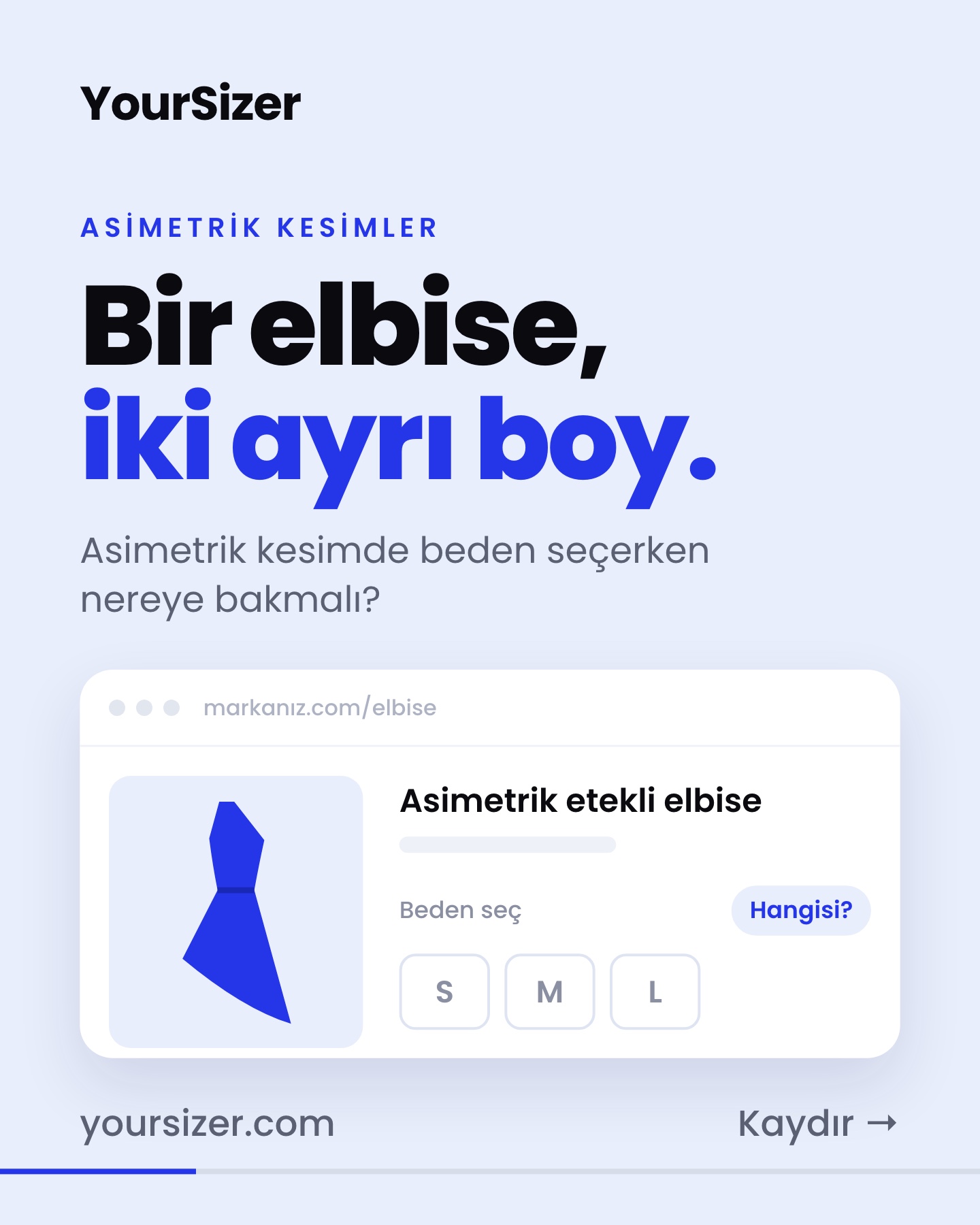
An asymmetric cut is any garment whose two halves are not mirror images: the front is shorter than the back, the left hem sits lower than the right, or only one shoulder is covered. That is exactly what makes these pieces striking in a product photo, and exactly what makes them hard to size from one. A standard size chart gives one length per size, which quietly assumes the hem sits at the same height all the way round. On an asymmetric dress it does not.
This guide covers both sides of the problem: how shoppers can read an asymmetric product page and choose a size, and what brands should measure and photograph so that the page tells the truth.
What Counts as an Asymmetric Cut
The list of hemline types on Wikipedia names three uneven hems: diagonal or asymmetric hems, high-low hems that are usually short in front and dip behind, and handkerchief hems. Necklines and fabric grain can be asymmetric too. A one-shoulder dress hangs from a single point, and a bias-cut drape pulls the fabric along a diagonal rather than straight down.
Each type moves the fit question to a different place.
| Cut | What is uneven | The measurement that matters | What to check before you buy |
|---|---|---|---|
| High-low hem | Front vs back length | Front length and back length, listed separately | Where the front lands on your leg, and whether the back clears the floor in your shoes |
| Diagonal hem | Left vs right side | Length at the shortest and the longest point | Both points against your own height |
| Handkerchief hem | Points that hang at different lengths | Length to the shortest point | Whether the shortest point is still the length you want |
| One-shoulder neckline | One strap carries the weight | Bust, plus shoulder-to-hem on the strap side | Bust fit and the underwear the style needs |
| Bias-cut drape | Grain runs on the diagonal | Flat measurements plus a note on give | How much the fabric opens across the body and whether it lengthens |
Why One Product Photo Is Not Enough
The default hero image is a front view. On a high-low dress, a front view shows the short side and hides the long one, which is the whole point of the design. On a diagonal hem, a front view flattens the slope, so the shopper cannot tell how far apart the two ends really are.
Baymard Institute's research on human model images argues that products meant to be worn need a body in the picture, because without one shoppers cannot judge critical attributes such as fit and length. It also recommends at least one unstyled worn image, since tucking, rolling or pinning can hide exactly those details. Baymard's apparel benchmark summary reports that 21% of benchmark sites provide no human model images and 24% do not let users easily understand an item's overall fit.
Shopify's clothing photography guide recommends showing front, back and sides. For an asymmetric cut, the side profile is usually the single most informative frame, because it is the only one that shows the hem slope from end to end.
How Shoppers Should Read an Asymmetric Size Chart
Look for two lengths, not one
A well-documented asymmetric listing gives you both ends. The Cynthia Rowley high-low dress listed on Garmentory, for example, gives a front length of 30 inches and a back length of 50 inches for size S, a 20-inch difference that a single length figure would have hidden. If a page lists only one length, do not guess whether it is the shortest point or the centre front; ask the seller.
Measure yourself against both ends
Stand straight and measure from the high point of your shoulder down to where you want the front hem to fall, then down to where you want the back hem to fall. Compare those two numbers with the garment's front and back lengths. If you plan to wear flats with a long back hem, measure in those shoes. Our guide on how to measure a dress shows where each tape position starts.
Pick the size from the fixed points, not the hem
An asymmetric hem is a styling decision; it does not change how much room the dress has at the bust, waist or hip. Choose your size from the tightest fixed point the garment has to fit, and treat length as a separate question that you answer with the front and back numbers. This is the same principle behind why dresses are hard to size online: a dress has several fit points, and the one with the least room decides the size.
Check whether it is cut on the bias
Some draped asymmetric dresses are cut on the bias, so look for the words bias cut in the description. According to Wikipedia's entry on fabric grain, true bias runs at 45 degrees to the warp and weft, woven fabric is more elastic and fluid in that direction, and a narrow dress cut this way will cling to the figure. A silk retailer's guide to bias-cut fit adds that if you are between sizes, a bias-cut silk nightgown usually looks better one size up than one size too small, and that bias silk can grow slightly if it is hung wet or pulled. In practice, the stated length on a bias hem is a starting point, not a ceiling. We go deeper on this in what is bias cut and how it affects fit.
On one-shoulder styles, trust the bust number
A one-shoulder dress has no second strap to share the load, so the fit at the bust is what keeps it in place. The Country Road one-shoulder dress on GlamCorner is a useful example of honest fit notes: bust, waist and hips are marked as fitted, the fabric is noted as having no stretch, and a strapless bra is suggested. On a non-stretch one-shoulder style, the bust measurement is the number to size by; if it falls between two sizes, the waist and hip notes tell you which way to lean.
What Brands Should Put on an Asymmetric Product Page
On the merchant side, the fix is mostly documentation. Baymard reports that more than 80% of apparel sites fail to provide sufficient sizing information, and asymmetric styles expose that gap faster than almost anything else, because the one number they usually publish is the one that varies.
| Page element | Why it matters for asymmetric cuts |
|---|---|
| Front and back length (or shortest and longest) per size | A single length is wrong for at least one side of the garment |
| Side-profile photo on a model | The only view that shows the full hem slope |
| Back view in the same framing as the front | Shows the long side of a high-low hem |
| At least one unstyled worn image | Styling can hide the true hem line |
| Model height and size worn | Lets shoppers translate the photo to their own body |
| Fabric behaviour note: bias, stretch or no stretch | Tells shoppers whether the girth and length numbers will move |
| Which side or shoulder is longer or covered | Matters for left-right asymmetry and for mirrored photos |
Baymard's apparel checklist also suggests giving measurements in both inches and centimetres and considering the measurements of human models. For practical layouts, see displaying model height and size on the product page and how product photography reduces returns.
When you measure the garment itself, lay it flat, let it relax, and take the length at centre front and centre back separately, plus the shortest and longest point if they differ from those. If the style is cut on the bias, handle it gently while measuring, since bias fabric can stretch or distort under rough handling, and check more than one unit before you publish the chart.
Where YourSizer Fits
YourSizer adds separate tools to the product page, and each answers a different part of the asymmetric question.
The size recommendation answers the girth question. It works from a few body inputs such as height, weight and fit preference and returns a size, which is the decision the fixed points of the garment drive. The length question is still best answered with the front and back numbers on the page, so the two work together rather than replacing each other.
The virtual try-on is photo-based: the shopper uploads or takes a photo and sees the garment on it. For a cut whose appeal is the line it draws across the body, that gives a visual sense of the look on the shopper's own figure. Separately, the 3D body model in the size flow shows a mannequin shaped by the shopper's measurements.
YourSizer is live on Shopify, ikas, Ticimax, T-Soft and IdeaSoft.
Frequently Asked Questions
Should I size up for an asymmetric dress?
Not by default. The asymmetry is in the hem or the neckline, not in the girth, so your usual size at the bust, waist and hip still applies. The exception is a fluid bias-cut style, where the silk retailer linked above advises going one size up rather than down on a bias-cut nightgown if you are between sizes.
How do I measure the length of a high-low dress?
Lay the dress flat and measure from the high point of the shoulder to the hem twice: once at centre front and once at centre back. Compare both numbers with the points on your own body where you want each end to land, measured in the shoes you plan to wear.
Which photos show an asymmetric cut best?
A front view, a back view in the same framing, and a side profile on a model, with at least one image left unstyled. The side profile is the shot many stores skip, and it is the one that shows the hem slope most clearly.
Are asymmetric hems harder for petite or tall shoppers?
They can be, because the same front and back lengths land at different points on different heights. Compare both lengths with your own measurements rather than with the model's, and check whether the brand offers petite or tall lengths. Our guide to petite, regular and tall sizing explains how those ranges differ.